
The Amitabha Sutra, Explained (29-32)
Passages 29 to 32: A deep understanding strengthens our belief and vow to reborn in the Western Pure Land
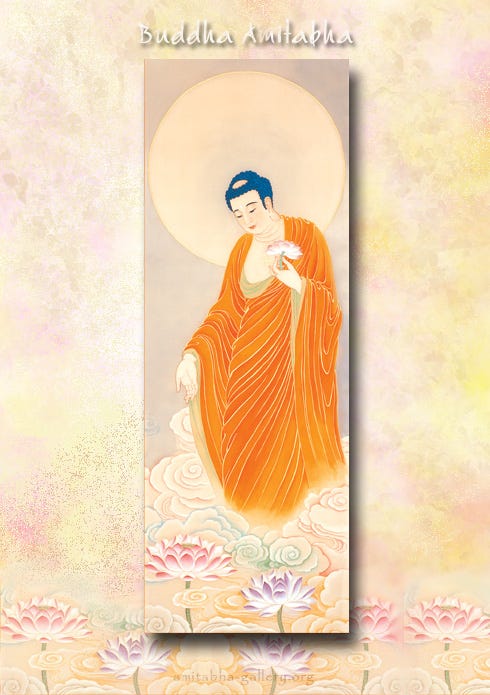
The detailed explanation of this sutra is divided into forty-eight passages offering a great introduction to the core Pure Land teachings.
A strong understanding of the sutra text helps deepen one's belief in the inconceivable power of Amitabha Chanting practice and strengthen one's vow to reborn in the Western Pure Land (the Land of Ultimate Bliss).
(…continued)
The Amitabha Sutra, Explained
~Commentary passages credited from the book, Pure Mind, Compassionate Hearts: Lessons from the Amitabha Sutra (Venerable Wuling, 2017).
Passages: 1-4 | 5-8 | 9-12 | 13-16 | 17-20 | 21-24 | 25-28 | 29-32 | 33-36 | 37-40 | 41-44 | 45-48
PASSAGE 29: NON-RETROGRESSION
None of the sentient beings who are born in the Land of Ultimate Bliss ever fall back into a lower realm.
This sentence assures us that all the beings in the Pure Land have reached the level of non-retrogression. This also means that they are always improving. The swiftness of their unceasing improvement is possible thanks to the support of Amitabha Buddha and the excellent learning conditions in the Pure Land.
In comparison to those conditions, ours here in samsara are woefully inadequate. How so? Being reborn as a human is incredibly rare; and when we do finally obtain a human rebirth, we may not live in a place where we can hear the teachings. Or, upon our hearing of this Dharma door and wanting to practice the teachings, we find that friends and family members oppose our practice. Perhaps our surroundings are so pleasurable that we are too distracted to practice. Alternatively, our surroundings may be so harsh that all we can think of is surviving for one more day. One way or another, we lack the good fortune to have suitable conditions for practice.
On the other hand, we could indeed be fortunate enough to hear the teachings, have time to practice, enjoy the support of friends and family members, and possess favorable surroundings for practice. But what if in the face of all our advantages we became arrogant and self-absorbed? We could squander our good fortune on personal enjoyments. Or feeling lazy and complacent, we could dismiss the urgency of practice saying there will be time another day.
For those and so many other reasons, we all too often regress in our practice to attain buddhahood.
The quickest way to attain buddhahood is to make continuous progress—to reach the level of non-retrogression. For beings like ourselves, this is best accomplished in a land that is tailored to accommodate our needs and shortcomings.
And so Sakyamuni told us that of all the pure lands, we should seek birth in the Western Pure Land of Ultimate Bliss, a land so ideal that Buddhas in the ten directions teach the Pure Land method and encourage all beings to seek birth there.
We can further appreciate the importance of this sutra passage assuring us of non-retrogression when we consider five fundamental reasons why we will never fall back in that land.
Five Reasons Why Never Fall Back
First is Amitabha Buddha's twentieth vow.
Of the beings who sincerely practice and chant his name, he said that at the end of their lives, along with an assembly of bodhisattvas, he would come to escort them. In an instant, they would be born in his land and become non-retrogressive bodhisattvas.
Furthermore, Amitabha concluded all forty-eight of his vows with the same pledge: if he did not fulfill the particular vow he would not attain perfect enlightenment.
Sakyamuni told us that Amitabha became a Buddha ten kalpas ago. This is our assurance that all of Amitabha's forty-eight vows were indeed fulfilled, including the vow of non-retrogression for all those born in his land.
Second, Amitabha supports all beings who sincerely chant his name.
Due to this support, all those in the Pure Land will never again regress. But one does not even have to wait to be born in the Pure Land to receive Amitabha's help. Those who sincerely practice and vow to be born in the Pure Land will receive his support even now, even here in samsara.
We can see how this works upon reading Amitabha's thirteenth and fourteenth vows. In these two vows, he pledged that when he became a Buddha, his light would be infinite. Universally illuminating the ten directions, it would be unsurpassed by any other Buddha's light and would exceed by a quadrillion times that of the sun and the moon. All beings who saw his light, who were illuminated by it, and who felt it touch their bodies, would be peaceful and joyous. They would perform virtuous deeds with compassion and eventually be born in his land. If all this were not so, he would not attain perfect enlightenment.
With his infinite light, Amitabha found a way to help and support us even while we are still in samsara. But if Amitabha's light is illuminating the ten directions, why do we not see it? We are not yet truly sincere in our chanting. It is as if, on a cloudless day, the sun shines brightly all around us, but we stand gripping an open umbrella directly overhead. In ignorance, we block the very light that is streaming unabatedly toward us.
Third, even the trees, railings, birds, and celestial breezes in the Pure Land teach the Dharma.
None of these happen in our world. We do not get to learn from the trees or the birds, from the nature that surrounds us. There is no continuous teaching, and so it is much easier for us to regress in our learning. And even when we do listen to teachers or read their books, it is still very easy to be lazy and to have wandering thoughts. In the Pure Land, however, we will be immersed continuously in the teachings. With Amitabha's support, our mind will naturally be pure and proper.
Fourth, in our world, one teacher instructs many students.
In the Pure Land, each being has a manifestation of Amitabha for a teacher. Furthermore, beings in the Land Where Sages and Ordinary Beings Dwell Together who wish to learn from other Buddhas can go to the lands of those Buddhas to learn from them. Beings in the Land of Real Reward who want to learn from other Buddhas will see a manifestation of that Buddha right in front of them. Thus, the beings in the Pure Land can effortlessly learn from countless Buddhas. How can anyone possibly regress with such extraordinary conditions and such excellent teachers!
Fifth, depending on the level of attainment in the Pure Land, afflictions will either be held at bay or eliminated.
Amitabha has created a world in which afflictions—which are serious obstacles to our progress—do not have any opportunity to arise. Therefore, there is no cause to bring about an effect that will trigger our regression.
For example, in accordance with his fifth vow, everyone has the same appearance. In our world, some people are very attractive, which can lead to arrogance. Others may not be as fortunate and, thus, suffer from feelings of low esteem. Both arrogance and a sense of inferiority are afflictions. The perfect equality of appearance in the Pure Land assures that such afflictions do not materialize, which in effect leads to their elimination.
These are the five fundamental reasons why we will always improve in our practice in the Pure Land. Because of such reasons, we will attain the three stages of non-retrogression. Those who have perfectly attained all three levels are bodhisattvas of the seventh ground and above.
Three Stages of Non-Retrogression
The first stage of non-retrogression is no falling back from one's level. One eliminates the affliction of views and, in so doing, attains the level of a sage, a being who has accomplished his goal.
The second stage of non-retrogression is no falling back from one's practice. One continuously progresses on the bodhisattva path and perseveres to fulfill the vow of "sentient beings are innumerable; I vow to help them all." Practitioners at this second stage do not fall back into seeking only their individual attainment. Now observant of others, they voluntarily go to them when their conditions have matured and they are ready to learn.
The third stage of non-retrogression is no falling back from one's mindfulness. One will never again fall back because every thought accords with prajna wisdom, the wisdom innate in the true nature.
These are the three stages of non-retrogression we attain by being born in the Pure Land. This wonderful attainment is due to Amitabha Buddha's support.
(Start your buddha-name chanting practice today by following a sample from the collection Amitabha Mindful Chanting music.)
PASSAGE 30: ONE LIFETIME AWAY FROM BUDDHAHOOD
Many among them have only one more lifetime to go before Buddhahood. Their number is incalculable: they can be spoken of as innumerable.
Here we learn that "many among them have only one more lifetime to go before Buddhahood." These are equal-enlightenment Bodhisattvas, awakened beings just one level below Buddhahood! And there are so many equal-enlightenment Bodhisattvas in that land that "their number is incalculable." In our world, we cannot find even one equal-enlightenment Bodhisattva, but in the Western Pure Land they are everywhere.
Avalokitesvara, Mahasthamaprapta, Manjusri, Samantabhadra, and Maitreya are all equal-enlightenment Bodhisattvas. When we are with such Bodhisattvas every day, how could we regress!
Where else can we have Amitabha Buddha and the Buddhas in the ten directions as our teachers? Where else can we have Bodhisattvas waiting to succeed Buddhas as our fellow practitioners? Where else can we find such a good learning environment?
If we truly understand all this, we will realize that our world fails completely in comparison to the Western Pure Land. With such understanding, we will not attach to anything in this world. Nothing will be able to keep us here. We will not want to be here. We will let go of all attachments and practice diligently and wholeheartedly to go to the Land of Ultimate Bliss. There is where we want to go. The sooner we go, the better off we will be. And the better off the beings still trapped in samsara will be. For once we are in the Pure Land we can help them as well, just as we vowed.
But if there is just one thing that we cannot let go of, we will not be able to go there.
We must let go of everything.
(Listen to a sample of Amitabha Mindful Chanting music, and start your chanting practice today!)
PASSAGE 31: VOW TO BE BORN IN THE PURE LAND
When sentient beings hear these teachings, they must take a vow to be born in this land. Why so? So that they can be together with all these Beings of Superior Goodness.
This is the first time in the sutra that Sakyamuni Buddha advised, "When sentient beings hear these teachings, they must take a vow to be born in this land."
In this short sutra, he urged us not once but three times to make a vow to be born in the Pure Land. Why so many times? Because this vow is of vital importance. Vow, belief, and practice are like the legs of a three-legged stool. Without any one leg, the stool cannot stand; without the vow, birth in the Pure Land cannot take place. And so, Sakyamuni repeatedly said in the sutra that those who hear it should vow to be born in this land.
When we truly vow and sincerely practice according to the Amitabha Sutra, we will develop the Bodhi mind to cultivate ourselves and help all beings. As we mindfully chant the Buddha-name, we will no longer be affected by our surroundings, our desires, or by others' opinions.
Chanting mindfully requires a degree of concentration and stability, and for this we need genuine vows and unwavering belief.
How do we develop our vow and belief?
We develop them by learning and practicing the Pure Land teachings and progressing step by step. Additionally, just like the legs of that stool, our belief, vow, and practice need to be balanced for all three are equally important.
Sakyamuni Buddha next told Sariputra that beings born in the Pure Land would "be together with all these Beings of Superior Goodness." These beings have eliminated greed, anger, ignorance, and arrogance. They practice the ten virtuous karmas, the six paramitas, and the ten great vows of Samantabhadra. Surrounded by such accomplished beings in that land, how could we not practice diligently and progress smoothly toward buddhahood?
And yet, despite knowing about the beings and the environment in the Pure Land, are we practicing diligently to go there? Great Master Ouyi said that practitioners who are not, lack belief in this Dharma door. Although they study and chant, they remain half convinced and half in doubt. Instead of believing in the utmost importance of fulfilling their vow to be born in the Pure Land, and hence spending time on it, they prefer spending time in satisfying their desires and indulging their senses. Too often, they choose these over mindful buddha-name chanting. A tragic mistake.
Great Master Ouyi was deeply distressed about this. He was not distressed with people not having opportunities to hear this sutra. That happens because they have overwhelming karmic obstacles. The master was concerned about the people who do have the opportunity to hear the sutra but let the opportunity slip by. They waste the chance to practice according to the teachings. Their belief and vow are not strong enough. And so such people, ruled by their afflictions and residual habits, continue to commit the ten evil karmas.
If we genuinely believe this Dharma door—if we sincerely vow to be born in the Pure Land—we will stop committing the ten evil karmas. We will practice the ten virtuous karmas. Why? Because with true belief, we will do everything possible to fulfill our vow and join "the Beings of Superior Goodness" in the Western Pure Land.
(Pick a sample of Amitabha Mindful Chanting music from this collection, and get started with your chanting practice today!)
PASSAGE 32: GOOD ROOTS, GOOD FORTUNE, CAUSAL CONNECTIONS
One cannot be born in this land through minor good roots, blessings, virtues (good fortune) and causal connections.
This sentence tells us what is needed to be born in the Pure Land: abundant and great good roots, not just minor ones, and right causal connections, not just any ones.
How do we get these?
By chanting the name of Amitabha Buddha. When we do so, we sure in the benefits derived from the good roots, good fortune, virtues, and causal connections of Amitabha and all other Buddhas. It is like that impoverished young man who, by living with his wealthy aunt, shared in her good fortune.
Additionally, when chanting, we uncover our own good roots, good fortune, virtues, and causal connections that are already within our true nature. Uncovering these is why chanting the buddha-name is so important.
Why do we obtain all these by chanting Amitabha's name?
Amitabha vowed that those who chant his name would be born in the Pure Land. This vow assures us that if we chant properly, we will receive his support. We do not get such support when we chant the names of other Buddhas. Why not? Because Amitabha's forty-eight vows resonate with our true nature and because we have an excellent affinity with him. Other Buddhas do not have Amitabha's forty-eight vows. Nor do we have a strong affinity with them. So the mutual resonance is not as powerful when we chant their names.
What are good roots, good fortune, and causal connections?
Good roots is our having firm belief and resolute vow. We have firm belief when we do not have the slightest doubt about the Pure Land teachings and when we understand and believe in the buddha-name chanting method. We have resolute vow when we let go of all worldly physical and mental concerns, and focus on being born in the Pure Land.
To accumulate and strengthen our good roots, we need to learn the Dharma. If we believe—but are unable to practice—then we do not have enough good fortune. We are not alone in this because in samsara the good roots and good fortune to become a Buddha are extremely rare.
Good fortune is making the vow to be born in the Western Pure Land, mindfully chanting the buddha-name, and practicing the teachings. It is meeting good fellow practitioners and learning and discussing the teachings with them to deepen our understanding. After we have this understanding, good fortune is applying what we believe and understand in our daily life, and single-mindedly chanting Amitabha's name.
To want to be a Buddha is the highest aspiration we can have. If we have enough good fortune, we will find it easy to concentrate on Amitabha's name and will not find ourselves distracted from the practice. If we do not yet have enough good fortune, we can work on letting go of our selfishness and doing good deeds for the sake of all beings.
Furthermore, it is crucial that we strive to always chant the buddha-name. This chanting makes it easier for our mind to become calm. Having a tranquil mind, we will better know how to help others. Gradually, as we help others, our good fortune will increase. This brings us full circle because having more good fortune makes it easier for us to concentrate on chanting the name of Amitabha, which is the wisest use of our good fortune. Using our good fortune unwisely, we will end up enjoying it here in samsara. Enjoying it here will be yet another tragic mistake because the good fortune of being reborn in samsara does not begin to compare with the good fortune of being born in the Pure Land.
Causal connections is having good conditions, those that enable us to practice. For this to happen, we need many conditions to occur.
First, we need to be reborn as a human, which is extraordinarily rare.
Second, we need to be reborn at a time when the teachings are present in the world.
Such a rebirth is so rare because the teachings are absent from this world of Endurance for prolonged periods of time. As we previously learned, Sakyamuni's teachings will only remain for 9000 more years, and Maitreya will not appear for another 5,670 million years after that. Additionally, even if the teachings are present in the world and we are reborn as humans during this time, we may not be in a place where we can learn them.
Third, if we do learn of the teachings, we may not be able to genuinely accept them.
Fourth, even if we do accept them, due to our personal situation, we may lack the conditions to practice.
Fifth, if we are able to practice Buddhism, we may encounter schools other than Pure Land, even though our roots are with the Pure Land school.
Sixth, even if we have the roots to encounter and learn the Pure Land teachings, we may not meet a teacher to learn from and practice under.
Finally, we may be able to hear of Buddhism, accept the teachings, later encounter the Pure Land method, and find our teacher, but then fail to make being born in the Western Pure Land of Ultimate Bliss the most important thing in our life!
All these are just some of the many problems we can encounter while trying to practice. Perhaps we can now begin to appreciate why it is so extraordinarily difficult for us to transcend samsara. Only when we have the good roots, good fortune, and good causal connections to accept and diligently practice the Pure Land Dharma door, without doubt or intermingling with other teachings, will we finally be able to transcend.
Understanding all this, we should value our good roots, good fortune, and causal connections, and seize this rare opportunity to be born in the Pure Land. The accumulation of such good roots and good fortune takes an unbelievably long time. If we sincerely vow to be born in the Pure Land and concentrate on chanting Amitabha's name, we will be paying our gratitude to all Buddhas, to all our parents of countless lifetimes, and to our own true nature.
This true nature has always existed, but we have yet to uncover it. And so we remain in a seemingly endless dream. We should not wish to dream of having the good fortune to be successful, to win the praise of others, or to enjoy our good fortune in the cycle of rebirth. In the cycle of rebirth, whether we are suffering or enjoying our good fortune, the only difference is that we are either in a bad dream or a pleasant dream. Either way, we are in a dream.
We do not practice Buddhism to have pleasant dreams. We practice to awaken from all dreams! This is why Sakyamuni Buddha told us to be mindful of and attach to Amitabha Buddha to be born in his land.
Up till now we have remained attached to our desires and opinions. Now, we need to sever our attachments to all that we like or dislike, to all that we are used to. We need, instead, to attach to the name of Amitabha Buddha so that we can always be mindful of him. Doing so, we will finally awaken and no longer be lost in a dream.
» Next: Passages 33-36 … continued
___
Note: These 48 commentary passages are extracted from the book Pure Mind, Compassionate Heart: Lessons from the Amitabha Sutra, which is available for download on eLibrary, Amitabha Gallery.
For non-profit purpose only. Do not use the material from this page and copyright it yourself. Unauthorized registration of a copyright or for commercial use will be regarded as a violation of law.
Start Amitabha mindful chanting practice today.
Make the vow to reborn to the Western Pure Land in this lifetime!
Namo Amitabha!